What Cannot Be Patented in India – Complete Guide with Examples
Understanding what cannot be patented in India can save you thousands of rupees and months of effort
Table of Contents
This guide is designed to empower inventors, startups, MSMEs, and professionals with the knowledge and strategies needed to navigate the complexities of patent exclusions in India. By understanding these exclusions, you can avoid costly mistakes, make informed decisions, gain strategic advantages, and create long-term value from your innovations. This guide will help you save money, time, and resources while maximizing your chances of securing meaningful intellectual property protection.
This complete guide on what cannot be patented in India is designed to empower inventors, startups, MSMEs, and professionals.
Understanding what cannot be patented in India can save you thousands of rupees and months of effort
1. What This Guide Will Do For You
This guide provides actionable insights and practical strategies to help you navigate the intricacies of patent exclusions in India, ensuring you make informed decisions and maximize the value of your inventions.
1.1 🚫 Avoid Costly Mistakes
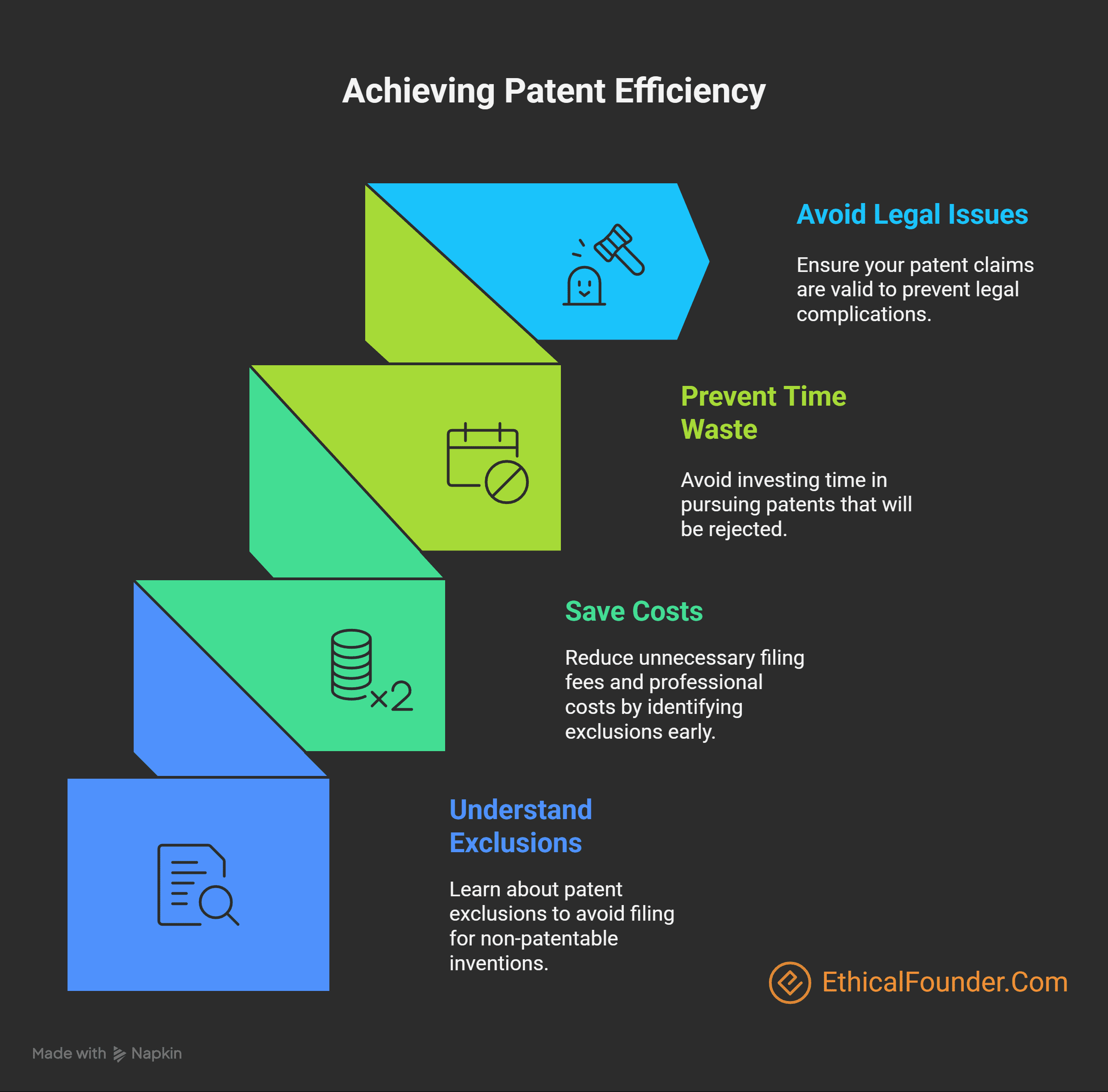
- Save ₹10,000-50,000 in unnecessary filing fees and professional costs: By understanding patent exclusions upfront, you can avoid wasting money on filing applications for inventions that are clearly not patentable under Indian law.
- Prevent 6-12 months of wasted time on non-patentable inventions: The patent application process can be lengthy. Identifying exclusions early on prevents you from investing significant time and effort into pursuing a patent that will ultimately be rejected.
- Avoid legal complications that could arise from invalid patent claims: Filing for a patent on an excluded subject matter can lead to legal challenges and invalidate your patent, potentially exposing you to liabilities.
1.2 Make Informed Decisions
- Instantly identify if your invention falls under excluded categories: This guide provides a clear and concise overview of the various categories of inventions that are excluded from patentability under Section 3 of the Indian Patents Act.
- Modify your approach to make non-patentable ideas patentable: Understanding the nuances of patent exclusions allows you to creatively modify your invention or its claims to circumvent the exclusions and make it eligible for patent protection.
- Focus your resources on inventions with genuine patent potential: By identifying and avoiding excluded subject matter, you can concentrate your resources on developing and protecting inventions that have a higher likelihood of being patented.

2. Long-term Value Creation
2.1 For Individual Inventors:
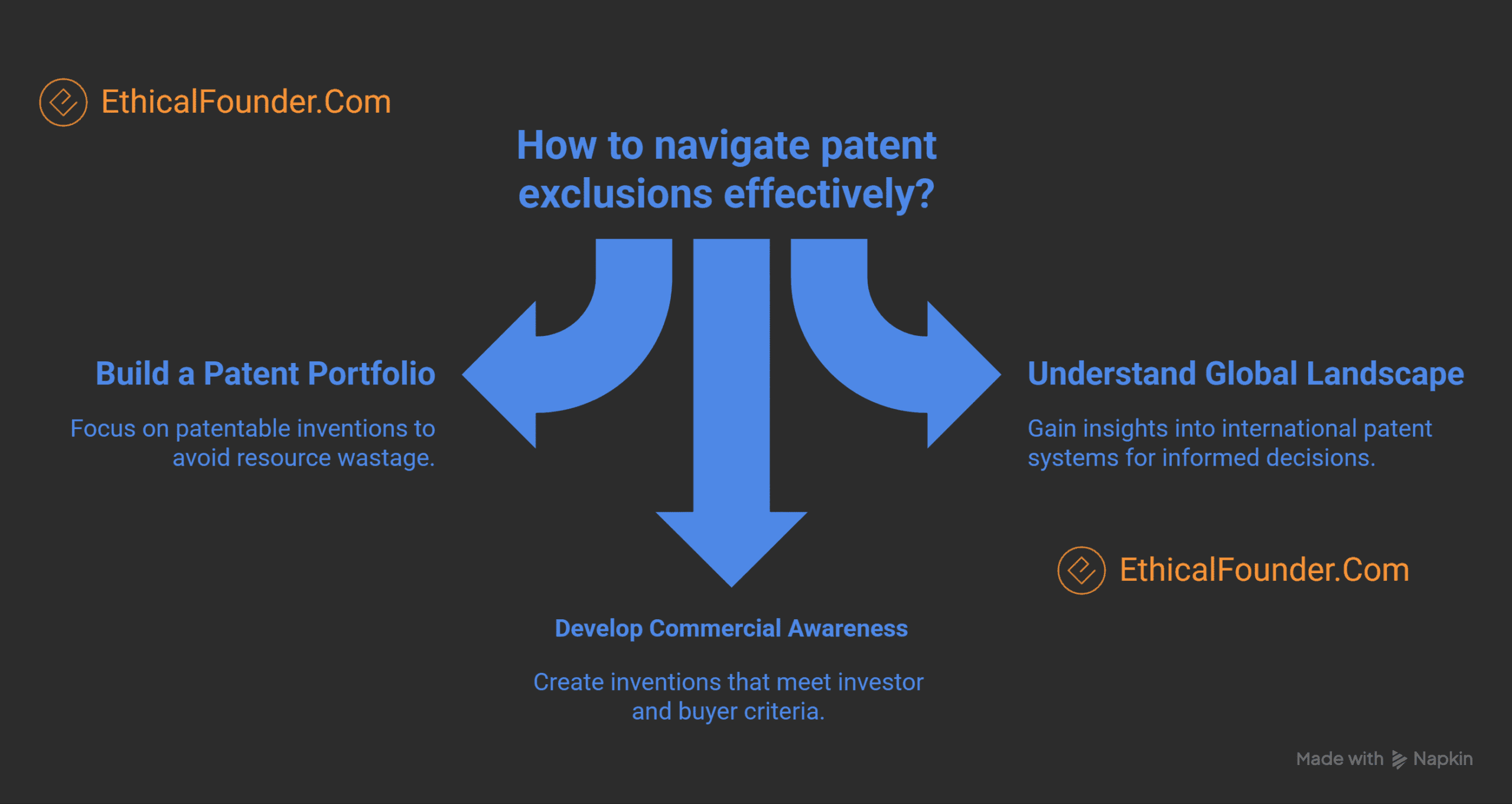
- Build a patent portfolio strategy that actually works: Understanding patent exclusions is crucial for developing a robust patent portfolio strategy that focuses on patentable inventions and avoids wasting resources on those that are not.
- Understand global patent landscape and how India fits in: This guide provides insights into the Indian patent system and its relationship to the global patent landscape, enabling you to make informed decisions about international patent protection.
- Develop commercial awareness of what investors and buyers want: Investors and buyers are looking for patents that are valid, enforceable, and cover commercially viable inventions. Understanding patent exclusions helps you develop inventions that meet these criteria.
2.2 For Startups & MSMEs:
- Risk assessment for R&D investments: By understanding patent exclusions, startups and MSMEs can conduct thorough risk assessments of their R&D investments, ensuring that they are focusing on developing patentable technologies.
- IP strategy alignment with business goals: This guide helps startups and MSMEs align their IP strategy with their overall business goals, ensuring that their patent portfolio supports their competitive advantage and market position.
- Due diligence preparation for funding rounds: Investors conduct due diligence to assess the value and risk of a company’s IP portfolio. Understanding patent exclusions helps you prepare for due diligence and demonstrate the strength of your IP assets.
2.3 For Professionals:
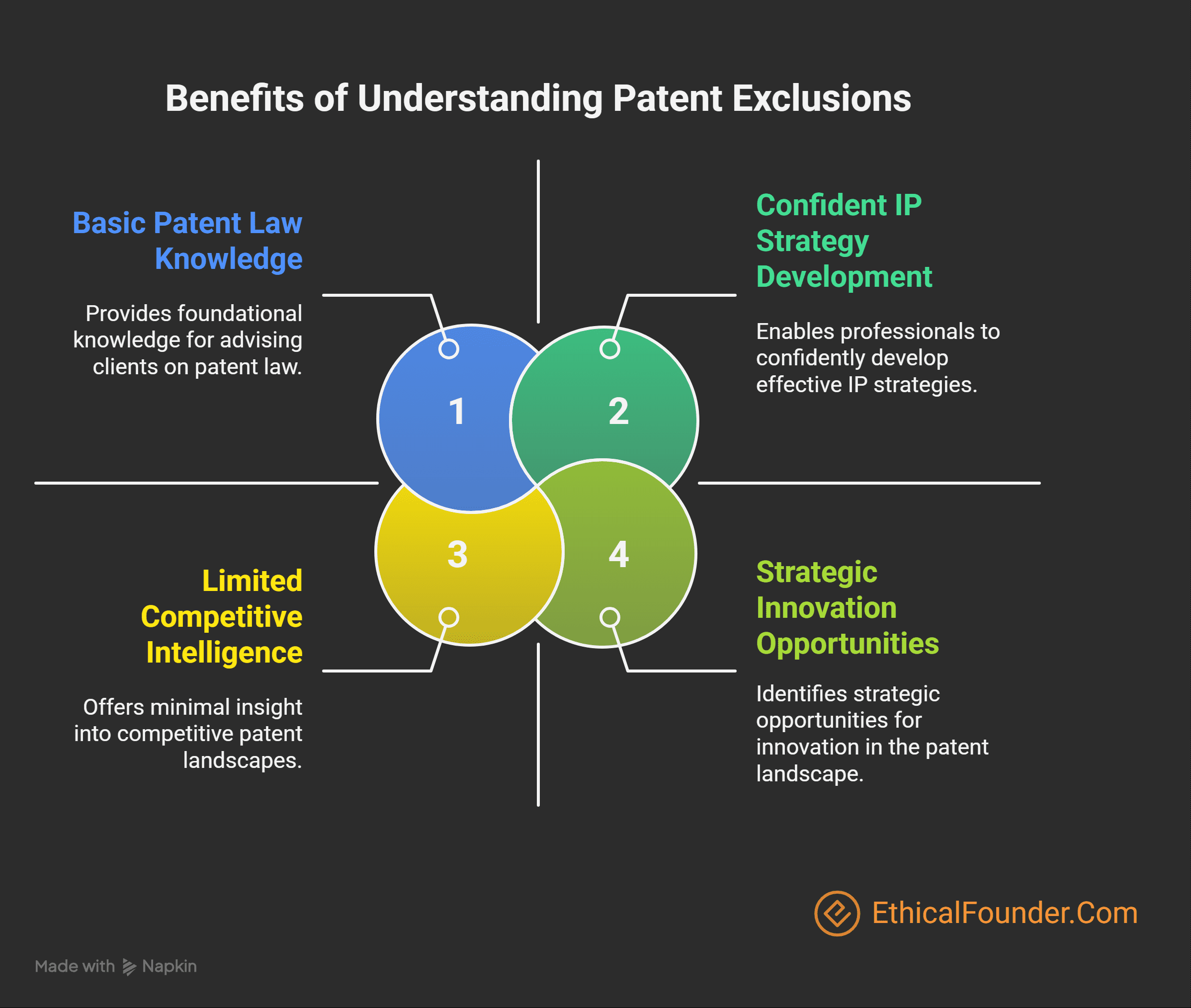
- Expert-level understanding of Indian patent law nuances: This guide provides professionals with a deep understanding of the nuances of Indian patent law, particularly in relation to patent exclusions.
- Consultation confidence when advising clients: With a thorough understanding of patent exclusions, professionals can confidently advise their clients on the patentability of their inventions and develop effective IP strategies.
- Competitive intelligence in patent landscape analysis: Understanding patent exclusions is crucial for conducting competitive intelligence and analyzing the patent landscape in a particular industry. This information can be used to identify opportunities for innovation and avoid infringing on existing patents.
Understanding the Legal Foundation: Indian Patent Law Exclusions
The Patents Act, 1970 – Section 3 and Section 4 Patents Act India
India’s patent exclusions are primarily defined in Sections 3 and 4 of the Patents Act, 1970. These sections were carefully crafted to balance:
- Innovation incentives vs public interest
- International obligations vs national priorities
- Economic development vs social welfare
Philosophy Behind Exclusions
Public Policy Considerations:
- Essential services (healthcare, education) should remain accessible.
- Traditional knowledge and natural resources belong to society.
- Basic research discoveries should benefit all humanity.
Economic Strategy:
- Prevent monopolization of fundamental business methods.
- Encourage genuine technological innovation over obvious improvements.
- Support domestic industry while respecting international agreements.
Category 1: Discoveries vs Inventions
What’s Not Patentable: Pure Discoveries
Legal Principle: You cannot patent something that already exists in nature – you can only patent how you use or modify it.
Examples of Non-Patentable Inventions in India:
- Discovery that a particular gene causes diabetes.
- Finding that a specific mineral has anti-bacterial properties.
- Identifying that certain plant compounds reduce inflammation.
Why These Are Excluded:
- They exist in nature independently of human intervention.
- Discovery doesn’t involve inventive activity.
- Public should have access to fundamental scientific knowledge.
Mathematical Methods & Algorithms
Non-Patentable Examples:
- New mathematical formula for calculating compound interest.
- Algorithm for solving differential equations.
- Statistical method for data analysis.
- Pure software code without technical application.
Key Insight: The algorithm itself isn’t patentable, but its technical application might be.

Category 2: Business Methods Not Patentable in India – Under Section 3(k)
What’s Excluded Under Section 3(k)
Legal Text: “A mathematical or business method or a computer program per se or algorithms”
Non-Patentable Examples:
- New accounting system or bookkeeping method.
- Marketing strategy or advertisement campaign approach.
- Customer loyalty program structure.
- E-commerce business model (like drop shipping).
- Banking transaction method.
- Insurance claim processing workflow.
Real-World Examples:
- Amazon’s “One-Click” purchasing – Patentable in US, not in India.
- Uber’s ride-sharing model – Business method, not patentable.
- Bitcoin mining algorithm – Mathematical method, not patentable.
The Technical Character Test
What Makes a Business Method Patentable: The invention must have technical character and solve a technical problem.
Patentable Business Method Applications:
- Point-of-sale system with specific hardware and software integration
- ATM security mechanism with biometric authentication
- Online payment gateway with encryption and fraud detection
- Supply chain tracking system with IoT sensors and blockchain
Case Study: Payment Systems
- Not Patentable: “Method for splitting restaurant bills among friends”
- Patentable: “Mobile payment apparatus with NFC chip, secure element, and tokenization for bill splitting”
Category 3: Software Patents in India – Computer Programs & Software
“Per Se” in patent law means “by itself” or “in its pure form”.
When the Patents Act excludes “computer program per se,” it means you cannot patent software code by itself – but you CAN patent software when it’s combined with hardware or produces a technical effect.
Example: A mobile app algorithm = not patentable per se. The same algorithm controlling a medical device = patentable because it’s not “per se” anymore.
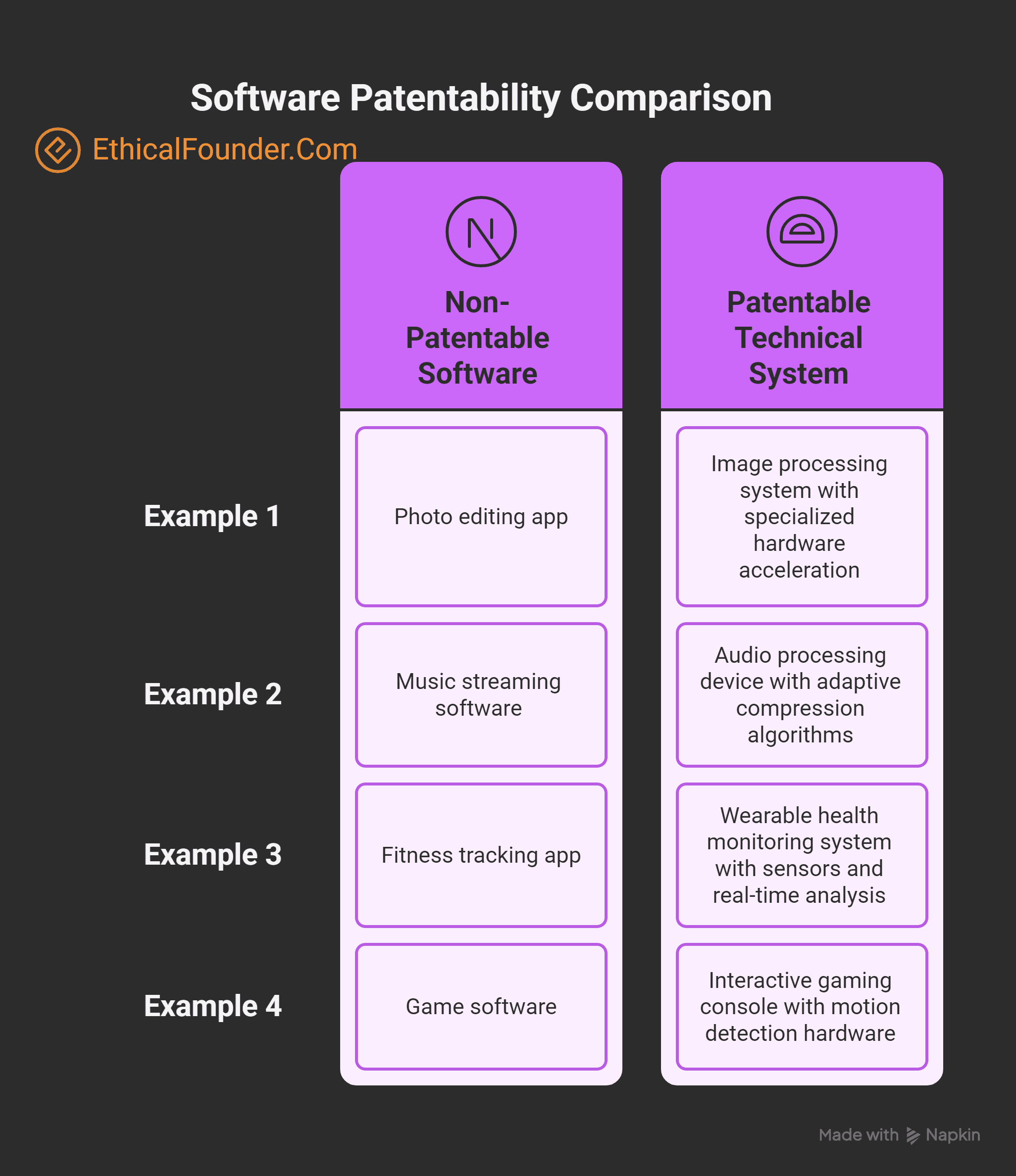
Non-Patentable Software
- Pure software code without hardware interaction
- Mobile apps that only process information
- Website functionality without technical innovation
- Database structures and data organization methods
- User interface designs and navigation methods
Examples:
- WhatsApp messaging protocol (software per se)
- Instagram photo filters (image processing software)
- Excel spreadsheet formulas (mathematical methods)
- Website recommendation algorithms (business methods)
Patentable Software Applications
- Medical diagnostic software that controls scanning equipment
- Industrial control systems that operate machinery
- Navigation systems that control vehicle functions
- Security software that manages hardware encryption modules
Category 4: Medical Methods Not Patentable in India – Section 3(i)
Methods of Treatment – Section 3(i)
Legal Principle: Methods for treatment of human beings or animals cannot be patented to ensure healthcare accessibility.
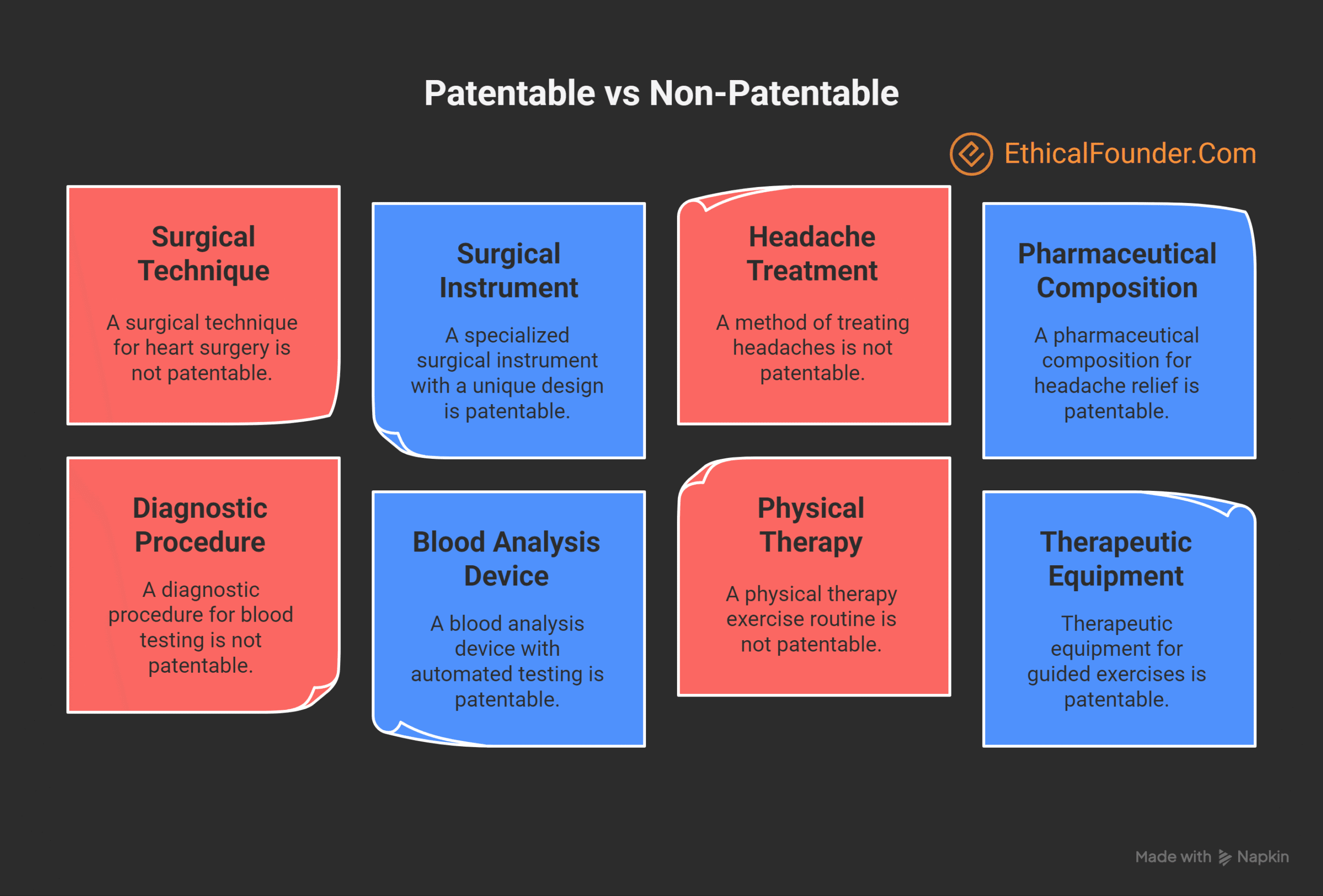
Non-Patentable Medical Methods:
- Surgical procedures and operating techniques
- Therapeutic methods and treatment protocols
- Diagnostic methods performed on living beings
- Cosmetic treatment procedures
- Physiotherapy and rehabilitation methods
Examples:
- Specific technique for cataract surgery
- Method for treating diabetes with diet and exercise
- Diagnostic procedure for detecting cancer using blood tests
- Yoga therapy for stress reduction
Patentable Medical Methods:
The Device/Composition Exception:
While treatment methods aren’t patentable, the tools and substances used for treatment can be.
Patentable Medical Inventions:
- Medical devices and surgical instruments
- Pharmaceutical compositions and drug formulations
- Diagnostic equipment and testing apparatus
- Medical software that operates devices
Category 5: Traditional Knowledge Patents in India – Folk Remedies & Natural Substances
Traditional Medicine & Folk Remedies
Section 3(p): Traditional knowledge or aggregation of known properties of traditionally known components.
What’s Protected from Patenting
- Ayurvedic formulations known in classical texts
- Traditional medicinal plants and their known uses
- Folk remedies passed down through generations
- Traditional agricultural practices and seeds
- Indigenous technical knowledge
Examples:
- Turmeric for wound healing (traditional knowledge)
- Neem for pest control (known property)
- Yoga poses and breathing techniques (traditional practice)
- Traditional metallurgy techniques
Making Traditional Knowledge Patentable
Novel Applications and Improvements:
- Standardized extraction methods for traditional medicines
- Novel combinations of traditional ingredients
- Modern delivery systems for traditional remedies
- Scientific validation and optimization of traditional methods
Success Example:
- Traditional Knowledge: Turmeric has anti-inflammatory properties.
- Patentable Innovation: Standardized curcumin extraction process with 95% purity and nano-encapsulation for enhanced bioavailability.
Category 6: Defense Patents in India & Atomic Energy Exclusions
Strategic Exclusions Under Section 4
Complete Prohibition Areas:
- Defense-related inventions of strategic importance
- Atomic energy applications for weapons
- Dual-use technologies that could threaten national security
Practical Impact:
- Nuclear reactor designs
- Missile guidance systems
- Military encryption methods
- Weapons technology
Converting Non-Patentable to Patentable
Strategy 1: Add Technical Character
Step-by-Step Process:
- Identify the core innovation in your idea
- Find technical problems it solves
- Add hardware components or technical implementation
- Demonstrate technical effects and improvements
Example Transformation:
- Original Idea: New method for teaching mathematics.
- Technical Addition: Interactive educational device with touch screen, adaptive learning algorithms, and progress tracking sensors.
- Result: Patentable educational technology system.
Strategy 2: Focus on Implementation, Not Concept
Reframing Approach:
- Don’t patent what you do.
- Patent how you do it technically.
- Emphasize technical advantages and improvements.
Business Method Example:
- Original Idea: New method for teaching mathematics.
- Patentable: “E-commerce system with real-time market analysis sensors, predictive algorithms, and automated pricing adjustment hardware”.
Strategy 3: Combination Innovation
Creating Patentable Combinations:
- Combine known elements in novel ways
- Show unexpected results or synergistic effects
- Demonstrate technical advantages of the combination.
Example:
- Individual components: GPS (known), Camera (known), AI software (known).
- Patentable combination: “Autonomous navigation system combining GPS, computer vision, and machine learning for obstacle avoidance in agricultural machinery”.
Decision Framework: Understanding Patentability in India
Quick Assessment Checklist
Question 1: Does your invention fall under any excluded category?
- Pure discovery or natural phenomenon
- Mathematical method or algorithm
- Business method without technical character
- Computer program per se
- Method of medical treatment
- Traditional knowledge
Question 2: Can you add technical character?
- Hardware components involved
- Solves a technical problem
- Produces technical effects
- Involves machine or manufacturing process
Question 3: Is there genuine innovation?
- Novel combination of elements
- Unexpected results achieved
- Technical advantages demonstrated
- Non-obvious to skilled person
🔍 Step 1: Patent Eligibility Deep Dive
Interactive Assessment Tool – Determine if Your Invention Qualifies for Patent Protection
Patent Potential Score
Click items above to get your personalized recommendation
Complete the assessment checklist to receive detailed guidance on your patent potential and next steps.
Smart Water Purification System
Innovation: UV purification with AI-powered contamination detection and automatic intensity adjustment
Why Patentable:
- Novel combination of UV + AI technology
- Solves technical problem of optimal purification
- Non-obvious integration approach
- Clear industrial application
New Business Model for Food Delivery
Idea: Dynamic pricing based on weather conditions and customer location
Why Not Patentable:
- Pure business method without technical character
- No hardware or technical implementation
- Mathematical calculation method
- Falls under Section 3(k) exclusions
Check For Patents

MSME registration guide
Start your business with our MSME registration guide. Learn Udyam registration process, eligibility, required documents, government portal steps and certificate benefits—perfect for startups, artisans and local service businesses across India.
MSME documents checklist
Get a complete MSME documents checklist for Udyam, GST, PAN, Aadhaar, bank statement, incorporation certificate and digital signature. Designed for proprietorship, partnership, LLP and private limited startups registering their small business in India.
Free business tools for MSME
Explore the best free business tools for MSME—CRM, invoicing software, GST billing, inventory apps, logo makers, domain search and website builders. Reduce startup costs and boost efficiency with tools tailored for small businesses in India.

MSME registration checklist
Follow our post MSME registration checklist to open current accounts, apply for GST, set up bookkeeping, issue invoices, register trademarks and meet compliance deadlines. A practical startup guide for MSMEs after completing Udyam registration.

MSME legal compliance
Understand MSME legal compliance —licenses, labour law, shop and establishment act, contracts, NDAs, privacy policy, and tax obligations. Our legal guide simplifies rules for startups, partnerships and small businesses navigating compliance challenges.

Trademark registration for MSME
Protect your brand with our trademark registration for MSME guide. Learn classes, search, TM-A filing, fees, objections and brand protection strategies. Tailored for startups and small businesses securing their identity in India.
Patent registration for startups
Step-by-step patent registration for startups. Covers prior art search, provisional and complete filing, IPO forms, fee reductions for MSMEs, timelines, design vs patent and innovation protection—perfect for entrepreneurs and inventors.
Government schemes for MSME
Unlock government schemes for MSME—SIDBI, NSIC, ZED certification, GeM, cluster development and subsidy programs. Learn eligibility, benefits, documents and application process with simple guidance tailored for Indian startups and small enterprises.

MSME loan guide
Compare options with our MSME loan guide —Mudra loans, collateral-free credit, NBFC lending, working capital, interest rates, CIBIL score, EMI calculation and required documents. Practical insights for small businesses applying for finance.

MSME subsidy guide
Save costs with our MSME subsidy guide . Learn capital subsidy, interest subvention, technology upgradation, ZED reimbursement, export incentives and state grants. Step-by-step application details for small business founders in India.

CGTMSE loan Eligibility Guide
Understand CGTMSE loan eligibility for collateral-free credit. Coverage limits, guarantee fees, bank process, documentation checklist, claim settlement and renewal explained clearly. Practical guidance for micro and small enterprises in India.
MSME, Startup Income Tax Guide
Simplify MSME startup income tax —presumptive taxation under 44AD/44ADA, ITR forms, deductions, TDS/TCS, audit limits, GST reconciliation and due dates. Designed for proprietors, partnerships, LLPs and private limited companies.
The Ethical Founder’s Software Guide
Let us do the heavy lifting. Our detailed guides and verified website links help you navigate the vast digital landscape for your MSME. We provide unbiased reviews and step-by-step guidance on the best productivity tools available. Make informed, ethical decisions to automate your workflow without the overwhelm.
AI Tools For MSME/Startup’s
Choosing the right software is crucial—it impacts your data, ethics, and budget. We don’t sell tools; we provide the ultimate curated guidance. Our detailed articles and verified website links help you navigate the digital landscape, from free AI productivity apps to essential MSME platforms
- The Influencer Choice: Nano Banana 2 boy attitude Prompt and Minimalist Zoomer Outfits are trending today
 The Influencer Choice: Nano Banana 2 boy attitude Prompt and Minimalist Zoomer Outfits are trending today Step-by-Step Guide: How to …
 - Middle East Flight Disruptions This Week: Your Air Travel Just ChangedMiddle East Flight Disruptions This Week: Your Air Travel Just Changed Remember those predictable travel plans? Dead. Here’s what actually …
- 45 Days of Hubris: The Real Highguard Shutdown Reasons & The Death of a Hero Shooter45 Days of Hubris: The Real Highguard Shutdown Reasons & The Death of a Hero Shooter Wait, before we dive …
- Amazon’s Latest Offer: How the inKind Gift Card Deal Redefines Dining DiscountsAmazon’s Latest Offer’s: How the inKind Gift Card Deal Redefines Dining Discounts Remember frantically searching for tiny coupons for your …
- New Data Shocks: Low Retirement Savings for Americans Demand Financial PreparednessNew Data Shocks: Low Retirement Savings for Americans Demand Financial Preparedness Remember all the optimistic talks about retirement planning? Dead. …
- 3 Secret AI Portfolio Management Tools That Hack Your Returns Fast3 Secret AI Portfolio Management Tools That Hack Your Returns Fast Have you ever wondered why investment banks always seem …
- 300% Faster Strikes: The Claude AI Battlefield Role in Israel Iran AI Warfare300% Faster Strikes: The Claude AI Battlefield Role in Israel Iran AI Warfare The joint US-Israeli air campaign that commenced …
- Pokopia Release Date and Early Access: Using the Pokopia Switch 1 GameShare Bridge to Play 24h EarlyPokopia Release Date and Early Access: Using the Pokopia Switch 1 Game Share Bridge to Play 24h Early The official …
- New Data on 401(k) Withdrawal Rate Strategies Impacts Your Financial FutureNew Data on 401(k) Withdrawal Rate Strategies Impacts Your Financial Future Remember the hyped 4% rule for retirement withdrawals? Dead. …
- March 2026 Offers: Top credit card welcome bonusesMarch 2026 Offers: Top credit card welcome bonuses March 2026 Remember passively waiting for generic credit card offers? Dead. Here’s …